

Table of Contents
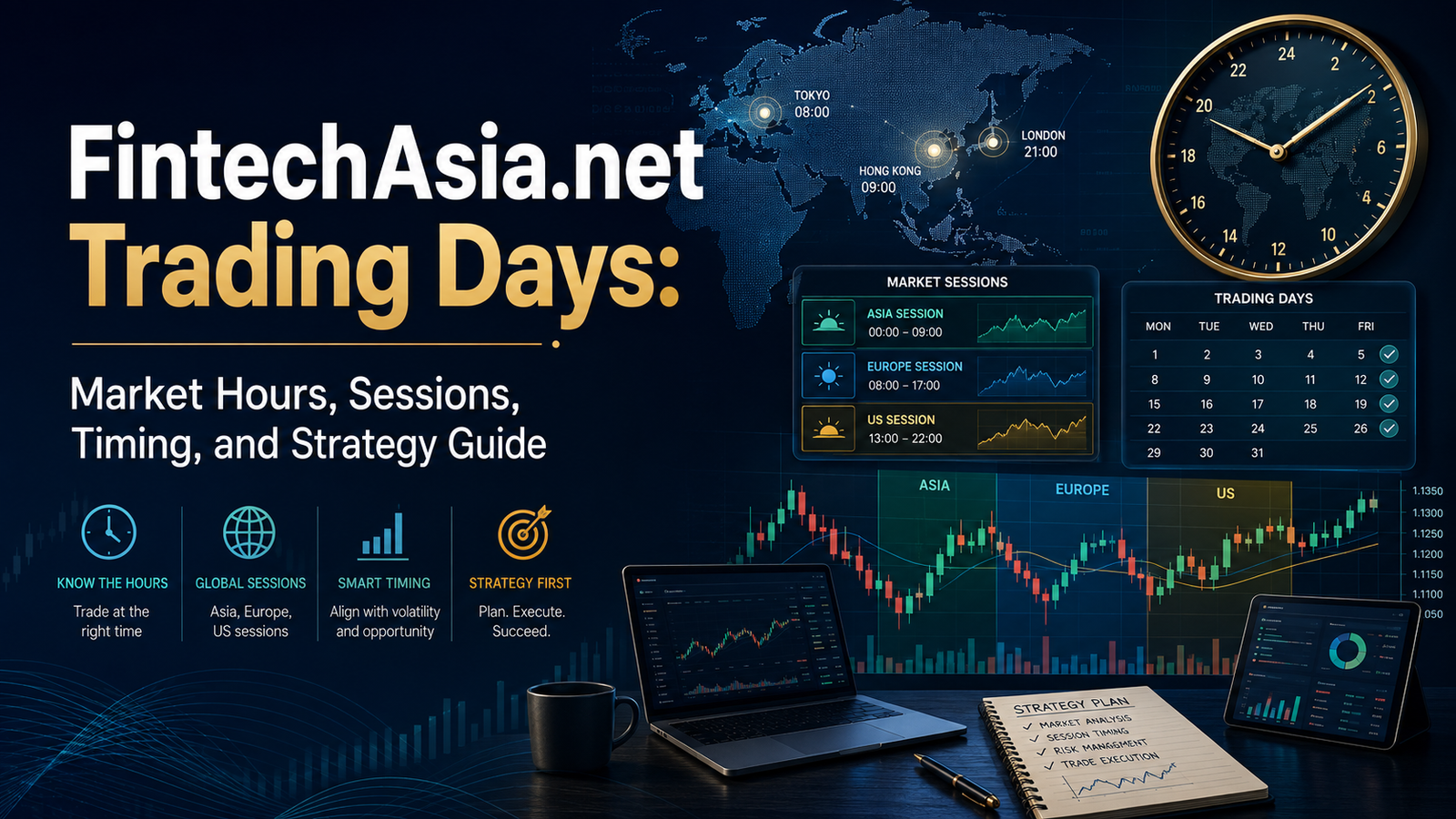
Understanding fintechasia.net trading days starts with a simple but important question: what exactly does the phrase refer to? Some readers use it to find an article published on FintechAsia.net, while others expect a calendar showing when Asian stocks, currencies, derivatives, or cryptocurrencies can be traded. These are related intentions, but they are not identical.
FintechAsia.net currently presents itself as a source of business and financial intelligence covering market movements, business developments, finance, and digital-asset trends. The site also published an article in November 2025 titled “Fintechasia.net Trading Days,” which discusses global market sessions and describes a 24/5 trading model. However, readers should not automatically interpret that wording as proof that FintechAsia.net itself is a regulated stock exchange or licensed brokerage service. Its visible homepage mainly operates as an editorial and financial-content destination. (Fintechasia)
This guide explains what trading days actually mean, how Asian exchange schedules work, why time zones and public holidays matter, and how readers can use fintechasia.net trading days information more responsibly. It also examines market liquidity, overlapping sessions, cryptocurrencies, economic announcements, risk control, and the difference between reading market content and executing a real trade.
What Does FintechAsia.net Trading Days Mean?

The keyword fintechasia.net trading days is best understood as a long-tail search phrase combining a website name with a market-timing question. A user may be searching for FintechAsia.net’s article, trying to determine when financial markets are open, or looking for favorable days and hours in which to trade.
A trading day is normally a date on which a particular exchange or marketplace accepts orders and conducts transactions. Traditional stock exchanges usually operate from Monday through Friday, excluding official exchange holidays. The exact hours, auction periods, lunch breaks, closing procedures, and settlement rules differ among markets.
The meaning becomes more complicated when currencies, commodities, derivatives, and digital assets are included. Foreign-exchange and many derivatives products may be accessible across most of the working week, while many cryptocurrency products trade through weekends. Therefore, no single “FintechAsia trading schedule” can accurately represent every asset.
A reliable interpretation of fintechasia.net trading days must identify the instrument first. A Hong Kong-listed share, Japanese stock, Indian equity derivative, currency pair, and cryptocurrency can all follow different schedules even when they appear inside the same trading application.
Is FintechAsia.net a Trading Platform or Information Website?
This question is essential because financial content and brokerage execution are different services. The current FintechAsia.net homepage describes its offering as business and financial intelligence and displays articles about market movements, business, taxation, digital assets, gaming, and other subjects. That presentation suggests that the public website primarily functions as a content publisher. (Fintechasia)
A separate article on the site describes FintechAsia.net as a trading ecosystem with tools, analytics, alerts, and 24/5 accessibility. Those statements appear within the site’s own editorial article, but the page does not, by itself, establish the existence of a regulated brokerage, exchange membership, client-money arrangements, or an independently verified order-execution system. (Fintechasia)
For that reason, readers researching fintechasia.net trading days should distinguish between educational descriptions and confirmed financial services. Before depositing money or submitting identity documents, a user should verify the legal company name, regulator, licence number, supported jurisdictions, fee schedule, custody model, withdrawal policy, and official customer agreement.
This does not mean the website’s articles have no value. Financial publications can help readers learn terminology and recognize market themes. The key is to use editorial content for research while relying on official exchanges, regulated brokers, and financial authorities for executable schedules and account-related decisions.
How Trading Days Work Across Financial Markets
A market’s trading calendar determines when new orders can be accepted and matched. It usually includes regular sessions, pre-opening auctions, continuous trading, closing auctions, settlement dates, public holidays, and occasional shortened sessions.
The fintechasia.net trading days concept becomes easier to understand when three separate ideas are recognized. The calendar day is the date displayed locally. The trading session is the period during which a market accepts activity. The settlement day is when ownership and money transfers are formally completed under the relevant market rules.
| Market Concept | Practical Meaning | Why It Matters |
| Trading day | A date on which the market conducts trading | Determines whether orders can be executed |
| Trading session | The opening and closing period within that day | Affects liquidity, volatility, and order timing |
| Market holiday | A date when an exchange is officially closed | Delays execution and may affect settlement |
| Settlement cycle | The period between transaction and completion | Determines when securities and funds are delivered |
| Pre-open auction | A price-discovery period before continuous trading | Helps establish an orderly opening price |
| Closing auction | A final matching process near the close | Can produce concentrated volume and price movement |
A broker may allow users to enter an order while the exchange is closed, but that does not necessarily mean the transaction occurs immediately. The order might remain queued until the next eligible session. This distinction is especially important for beginners who assume that an always-accessible app means the underlying market is always open.
Major Asian Stock Exchange Trading Hours

Asian stock markets do not share one universal timetable. Each exchange establishes its own local hours and holiday calendar. The examples below illustrate why readers researching fintechasia.net trading days must verify the specific market rather than relying on a general 24/5 statement.
The Tokyo Stock Exchange conducts its morning session from 9:00 a.m. to 11:30 a.m. and its afternoon session from 12:30 p.m. to 3:30 p.m. Japan Exchange Group states that the market is closed on Saturdays, Sundays, national holidays, January 1 through January 3, and December 31. (JPX)
Hong Kong’s securities market normally has a pre-opening session from 9:00 a.m. to 9:30 a.m., morning continuous trading from 9:30 a.m. to noon, and afternoon trading from 1:00 p.m. to 4:00 p.m. A closing auction can continue until a random close between 4:08 p.m. and 4:10 p.m. Trading is generally conducted Monday through Friday except public holidays. (Hong Kong Exchanges and Clearing)
Singapore’s normal-day securities schedule includes a morning trading phase from 9:00 a.m. to noon and an afternoon phase from 1:00 p.m. to 5:00 p.m. SGX also applies opening, closing, and non-cancel market phases around normal trading. (SGX Rulebook)
India’s National Stock Exchange lists normal equity-market trading from 9:15 a.m. to 3:30 p.m., followed by a closing session from 3:40 p.m. to 4:00 p.m. Separate schedules apply to block deals, derivatives, commodities, currencies, debt products, and T+0 transactions. (NSE India)
| Exchange | Regular Cash-Equity Schedule | Local-Time Notes |
| Tokyo Stock Exchange | 9:00–11:30 and 12:30–15:30 | Midday break |
| Hong Kong Stock Exchange | 9:30–12:00 and 13:00–16:00 | Pre-open and closing auction also apply |
| Singapore Exchange | 9:00–12:00 and 13:00–17:00 | Market phases surround continuous trading |
| National Stock Exchange of India | 9:15–15:30 | Pre-open and closing sessions are separate |
These times are useful examples, not a substitute for the current official exchange calendar. Exchanges may revise schedules or announce special arrangements, so users should confirm them before placing time-sensitive orders.
Why Time Zones Matter for FintechAsia.net Trading Days
Time-zone conversion is one of the most common sources of confusion in international trading. A market may be open during normal business hours in its home country but appear to open early in the morning, late at night, or on a different calendar date for an overseas investor.
A reader using fintechasia.net trading days from Pakistan, for example, must convert Tokyo, Hong Kong, Singapore, or Indian market times into Pakistan Standard Time. Daylight-saving changes create additional complexity when Asian markets overlap with London or North American sessions, even though most major Asian financial centres do not change their clocks seasonally.
Using an incorrect offset can lead to missed openings, orders being submitted after the close, or confusion about economic announcements. It can also affect chart interpretation. A daily candle on one platform may use a different session boundary from another provider, particularly for currencies and cryptocurrencies.
The safest practice is to set a trading application to the exchange’s local time or clearly display both local and user time zones. A serious trader should also confirm whether an announced event time refers to local time, Coordinated Universal Time, Eastern Time, or another regional standard.
Trading Days Versus 24/5 Market Access
The FintechAsia.net article associated with this keyword states that the described platform operates on a 24/5 basis. That language resembles the schedule often associated with global currency and some derivatives markets, where activity moves between Asian, European, and American financial centres during the working week. The statement should still be treated as the website’s description, not independent confirmation of a regulated FintechAsia.net execution service. (Fintechasia)
In practical terms, 24/5 does not necessarily mean that every instrument trades continuously without interruptions. Different products may have daily maintenance windows, regional pauses, reduced overnight liquidity, holiday closures, or broker-specific restrictions.
This is why fintechasia.net trading days should not be reduced to the phrase “open all week.” A platform interface may remain accessible while the selected exchange is closed. Market data may continue updating for one asset while another remains inactive. A user may also be able to manage account settings without being able to execute an immediate transaction.
Trading availability, liquidity, settlement, and customer support are separate operational matters. Understanding those differences can prevent mistaken assumptions and poorly timed orders.
Cryptocurrency Trading Days and Weekend Access
Cryptocurrency markets are often described as continuously accessible because digital assets can trade outside the weekday schedules used by traditional stock exchanges. Some regulated crypto-related futures products have also moved toward extended or 24/7 access, although maintenance periods, permissions, clearing arrangements, and product-specific restrictions can still apply.
In May 2026, the United States Commodity Futures Trading Commission issued guidance addressing the growing interest in 24/7 trading, clearing, and settlement. The advisory noted that digital infrastructure and global reach can make crypto-related derivatives more suitable for continuous access than some traditional products, while still emphasizing regulatory, operational, and risk-management obligations. (CFTC)
The relationship between crypto and fintechasia.net trading days therefore requires careful wording. A cryptocurrency may trade during the weekend, but the trader’s bank, payment service, derivatives provider, or withdrawal network may follow different operating schedules.
Continuous access can also increase pressure to monitor prices constantly. Availability should not be confused with opportunity. Lower-liquidity periods can produce wider spreads, sharp price movements, and poor execution. The market being open does not mean a trade is necessary.
How Public Holidays Change Trading Calendars
A Monday-to-Friday schedule still includes many exceptions. Exchanges close for national holidays, religious observances, year-end periods, and officially declared special events. Some markets use half-day sessions before major holidays, while others hold special sessions that follow different rules.
Anyone researching fintechasia.net trading days should check the relevant exchange calendar before the beginning of each month. Asian markets do not observe the same holidays. Lunar New Year affects several East Asian markets, Diwali influences Indian schedules, and Japan has its own national-holiday calendar.
Holiday differences can create unusual market conditions. One major exchange may remain open while a related regional market is closed. This can reduce participation, alter cross-market price discovery, or delay reactions until traders return.
The effect can continue after reopening. Orders and news may accumulate during the closure, producing a price gap or concentrated volatility at the next open. This is one reason traders should review open positions before long weekends instead of assuming that the market will resume near its previous closing price.
The Importance of Session Overlaps
Trading-session overlaps occur when two major regions are active at the same time. These periods can attract more participants, creating greater volume and tighter spreads in heavily traded instruments. However, they can also produce faster price movement and increased risk.
A strong fintechasia.net trading days guide should explain that “busy” does not automatically mean “profitable.” Increased liquidity may make entry and exit easier, but rapid reactions to economic data can create slippage and false breakouts.
The Asian session is especially important for instruments connected with Japan, China, Hong Kong, Singapore, Australia, and regional currencies. Later, the transition toward Europe can change participation and volatility. When North American markets become active, another major shift may occur.
Rather than memorizing a supposedly perfect hour, traders should observe how their chosen instrument behaves during different sessions. A strategy designed for calm range trading may perform poorly during a high-impact overlap, while a breakout approach may struggle during thin and directionless conditions.
Best Days of the Week for Trading
There is no universally best trading day. Market behaviour depends on the asset, economic calendar, corporate announcements, investor positioning, holidays, and current volatility. Claims that Tuesday or Thursday is always the most profitable should be treated cautiously unless supported by instrument-specific research.
For readers exploring fintechasia.net trading days, the more useful question is whether the current session matches their strategy. A day with high volume can suit traders who require quick execution, while a quieter session may benefit someone using a range-based method.
Monday can reflect reactions to weekend events. Midweek sessions may contain major economic announcements, central-bank decisions, or corporate releases. Friday can involve position adjustments ahead of the weekend. These are tendencies rather than guarantees.
A disciplined trader studies historical data for the exact market, timeframe, and strategy being used. The objective is not to find a magical weekday but to identify conditions under which a tested process has a reasonable opportunity to work.
Economic Events That Can Affect Trading Days
Interest-rate decisions, inflation reports, employment figures, economic-growth data, policy announcements, corporate earnings, and geopolitical developments can all change trading conditions. Their influence may begin before the official release as investors adjust positions and expectations.
This means fintechasia.net trading days research should include an economic calendar, not just opening and closing times. A market may be open normally while behaving very differently because an important announcement is approaching.
Price movement can become unstable during an unexpected result. Spreads may widen, order books can thin, and stop orders may execute at prices different from the level originally displayed. These effects are particularly important for leveraged products.
News should not be interpreted in isolation. A strong economic number can sometimes weaken a market when expectations were even higher. The direction of the reaction depends on what participants had already priced in, how the result compares with forecasts, and what it implies for future policy.
Liquidity, Volatility, and Execution Quality
Liquidity refers to the ability to buy or sell without causing an excessive price change. Volatility measures the extent and speed of price movement. The two concepts influence how effectively an order can be executed.
During active fintechasia.net trading days, a popular instrument may have a narrow difference between its bid and ask prices. During a quiet session, holiday period, or unexpected event, that spread may become wider.
Execution quality matters because a correct market prediction can still produce a poor result when costs are high. Spread, commission, financing charges, taxes, slippage, and currency conversion can reduce returns.
A trader should evaluate performance after costs rather than focusing only on gross gains. This is particularly important for frequent trading, where small charges accumulate across many transactions.
Limit orders can provide greater price control but may remain unfilled. Market orders prioritize immediate execution but may receive an unexpected price during rapid movement. Neither order type is always superior; the appropriate choice depends on liquidity, urgency, and risk tolerance.
Risk Management During Active Trading Sessions
Trading days create opportunities, but they also expose capital to loss. Investor.gov describes day trading as extremely risky and warns that substantial losses can occur within a short time. Leveraged products can increase both gains and losses, and in some structures the damage may exceed the amount initially committed. (Investor)
A responsible approach to fintechasia.net trading days begins with defining how much can be lost on a single position and across the entire session. The risk limit should be established before market movement creates emotional pressure.
Position size should reflect the distance to the exit level rather than the trader’s desired profit. A wider protective stop generally requires a smaller position when account risk is kept constant.
Loss limits can also prevent revenge trading. After several unsuccessful decisions, the urge to recover money immediately may lead to larger positions and weaker analysis. Stopping for the day can protect both capital and judgment.
Risk management cannot guarantee success, but it can reduce the chance that one unexpected event destroys an account.
How to Verify a Trading Website Before Using It
A polished website and professional article do not prove that a financial service is regulated. Before relying on any provider connected with fintechasia.net trading days, users should identify the legal entity that would hold their funds and execute their orders.
The regulator’s official database should confirm the firm’s licence, authorised activities, registered address, and current status. The domain name and contact details should match the official record. Users should be cautious when a service promises guaranteed profits, applies pressure to deposit immediately, or requires payment through an unrelated individual.
Withdrawal terms deserve the same attention as deposit methods. A legitimate-looking dashboard has little value when customers cannot retrieve funds under clear conditions.
It is also sensible to test customer support, read the client agreement, understand dispute procedures, and confirm whether negative-balance protection applies. Educational articles can support research, but legal documents and regulator records determine the actual relationship between a trader and service provider.
A Practical FintechAsia.net Trading Days Routine
A useful routine begins before the market opens. The trader confirms the exchange calendar, session time, economic announcements, active instruments, and maximum acceptable loss. This preparation reduces rushed decisions.
During fintechasia.net trading days, attention should remain limited to markets that the trader understands. Watching too many charts can create conflicting signals and encourage impulsive trades.
The plan should identify valid conditions for entry, exit, position size, and trade cancellation. A setup that does not meet the rules should be ignored, even when the market appears exciting.
After the session, the trader can record the reasoning, execution, result, costs, and emotional state. Reviewing this information over several weeks is more useful than judging skill from one profitable or losing day.
A routine also needs an ending. Constant market access can encourage overtrading, especially in crypto. A defined stopping time protects concentration and prevents trading from interfering with sleep, work, and personal responsibilities.
My Opinion on FintechAsia.net Trading Days
In my opinion, fintechasia.net trading days is a useful search topic, but the phrase can easily create confusion. The strongest interpretation is that it refers to educational content about when markets operate, not a universal schedule for a single confirmed exchange.
I would not rely solely on a general article claiming 24/5 access. I would first identify the asset, exchange, broker, local time zone, holiday calendar, and settlement rules. Official exchange websites should be the final source for trading hours.
I also believe beginners often spend too much time searching for the “best day” and too little time learning about risk. Timing matters, but it cannot repair an untested strategy, excessive leverage, poor position sizing, or emotional decision-making.
FintechAsia.net may help readers discover financial topics, but execution decisions require stronger verification. A responsible user should treat online articles as a starting point and then confirm every important detail through official market and regulatory sources.
Conclusion
The term fintechasia.net trading days can refer to the FintechAsia.net article, general Asian market schedules, or the days and sessions available for trading different financial assets. These meanings should not be treated as interchangeable.
FintechAsia.net’s current public homepage presents business and financial content, while one of its articles describes a 24/5 trading model. That claim should be understood as the site’s own description rather than independent evidence that the website itself operates as a regulated broker or exchange. (Fintechasia)
Traditional Asian stock exchanges follow defined weekday schedules with local holidays, auctions, breaks, and closing procedures. Currency and derivatives markets may offer longer weekday access, while digital assets can remain available during weekends. Even then, maintenance, liquidity, settlement, and provider restrictions still matter.
The best way to use fintechasia.net trading days information is to identify the exact asset first, verify the schedule through the official exchange, convert the time zone correctly, review upcoming events, and establish risk limits before placing an order. Trading availability can create an opportunity, but discipline determines whether that opportunity is approached responsibly.
Frequently Asked Questions
What are FintechAsia.net trading days?
FintechAsia.net trading days is a search phrase connected with the website’s market-timing content. The exact trading schedule depends on the underlying stock exchange, currency market, derivatives venue, cryptocurrency platform, and asset being traded.
Does FintechAsia.net operate 24 hours a day?
A FintechAsia.net article describes a 24/5 model, but the public website mainly appears to function as a financial-content publisher. Readers should independently verify whether any associated trading service is regulated and what products or hours it actually supports. (Fintechasia)
Are Asian stock markets open on weekends?
Major Asian stock exchanges are generally closed on Saturdays, Sundays, and their official market holidays. Special sessions can occur, so traders should check the exchange’s current calendar before placing an order.
What is the best trading day of the week?
There is no guaranteed best day. The most suitable day depends on the chosen asset, liquidity, volatility, economic events, strategy, transaction costs, and the trader’s risk plan.
Is day trading safe for beginners?
Day trading carries significant risk and may cause substantial losses quickly, particularly when leverage is involved. Beginners should learn how the product works, practise risk control, and avoid using money they cannot afford to and more.
