

Table of Contents
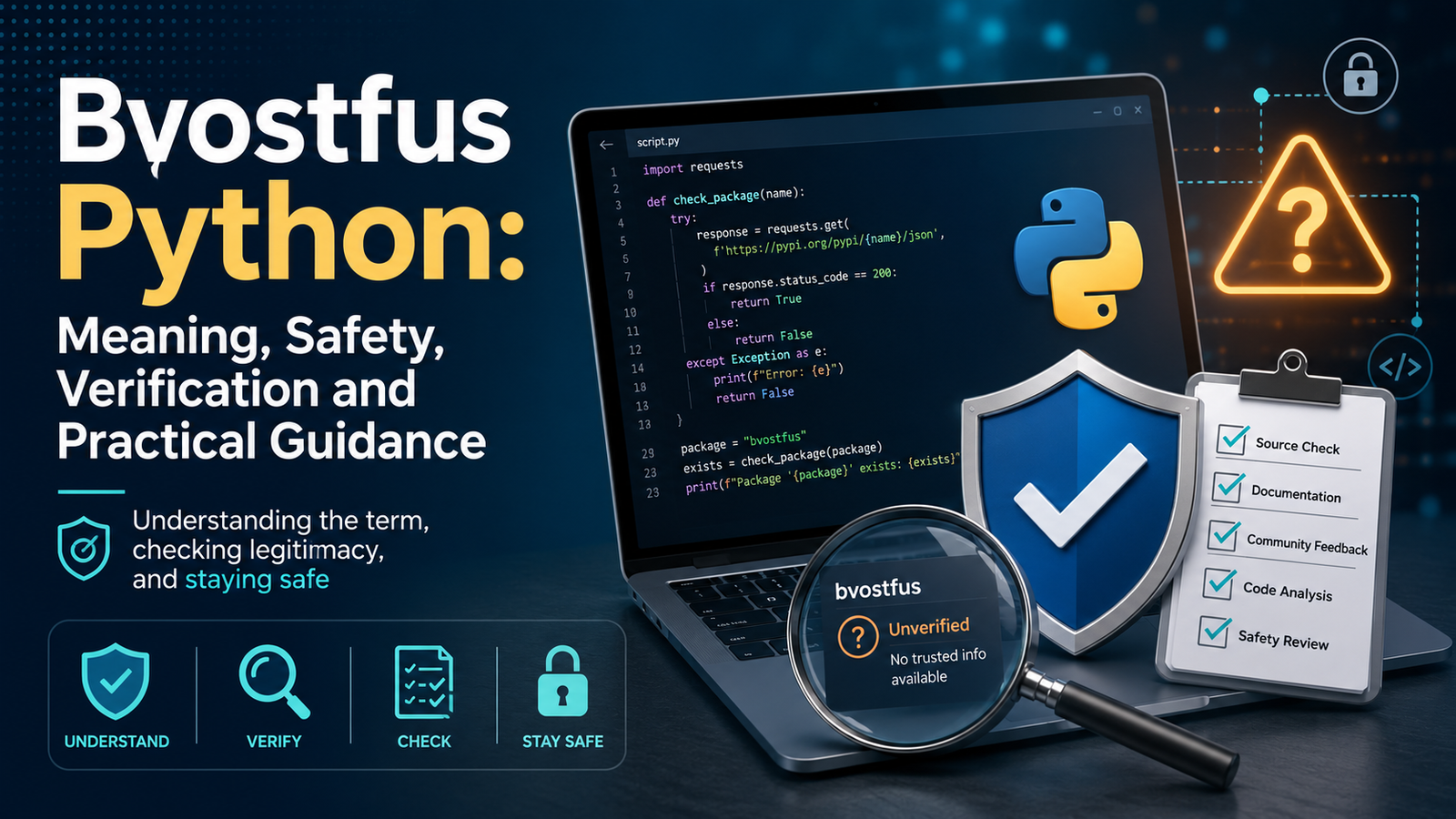
The phrase bvostfus python has recently appeared in technology searches, blog posts and online discussions. People searching for it may expect to find a new Python framework, development environment, automation tool or downloadable software package. However, the available evidence does not yet support those assumptions.
As of 28 July 2026, no established Python Package Index project can be verified under the names “bvostfus” or “bvostfus-python.” Direct requests to the corresponding PyPI project data endpoints return a not-found response. A GitHub search produces a very small HTML-only repository containing one file, no published releases and no recognised Python package code.
That does not necessarily mean the keyword is meaningless. It may be a newly created project name, an unpublished internal tool, a brand, a search trend, a misspelling or a phrase generated by automated content systems. This guide explains what is currently known about bvostfus python, how to evaluate claims surrounding it and what developers should do before downloading unknown software.
What Is Bvostfus Python?
At present, bvostfus python is best described as an unverified technology-related search term rather than an officially documented Python product. There is no dependable evidence showing that it is part of the Python standard library, an established framework or a recognised open-source development tool.
A genuine Python project normally leaves a clear technical trail. It may have a PyPI listing, source-code repository, documentation website, licence, version history, named maintainers, installation instructions, issue tracker and community activity. These signals allow developers to understand what the software does and who is responsible for maintaining it.
The available information for this particular phrase does not currently provide that level of transparency. Some independent websites describe it as a development guide, package manager, automation platform or structured Python environment, but those descriptions are inconsistent. More importantly, they are not supported by authoritative package records or maintained technical documentation.
| Verification Area | Current Finding |
| Official Python component | Not identified |
| PyPI project under “bvostfus” | Not found |
| PyPI project under “bvostfus-python” | Not found |
| Established Python source repository | Not identified |
| Official installation documentation | Not identified |
| Verified maintainer information | Not identified |
| Public release history | Not identified |
| Recognised community adoption | Not established |
For that reason, readers should avoid treating promotional explanations of the term as confirmed product documentation. The safest interpretation is that bvostfus python remains an unclear or emerging phrase whose technical identity has not been demonstrated.
Why Are People Searching for Bvostfus Python?
Several factors may explain why searches for bvostfus python are appearing even though the underlying software cannot be clearly verified. One possibility is that it represents a new brand or private development project that has not yet been publicly released.
Another explanation is a spelling variation. Users may have encountered the term in a screenshot, social media post, automatically generated article or poorly formatted document. A small spelling error can produce a completely different search phrase, particularly when technical product names are unfamiliar.
The keyword may also be associated with websites publishing content around low-competition search queries. In this situation, multiple articles can make a phrase appear established even when each article is repeating information from other unverified pages. Repetition creates visibility, but it does not automatically create evidence.
Search interest can therefore develop before a real product exists. This is why search volume, article quantity and social media mentions should not be treated as proof that a Python package is authentic.
Is Bvostfus Python an Official Python Package?
There is currently no reliable indication that bvostfus python is an official Python package. Python’s recognised third-party packages are generally distributed through the Python Package Index, commonly called PyPI. The official Python documentation describes PyPI as a public repository through which open-source Python packages are made available to users.
The package installer known as pip normally retrieves packages from PyPI unless another source is explicitly provided. The Python tutorial confirms that pip can install, upgrade and remove packages and that its default package source is the Python Package Index.
A direct check for matching PyPI project data returned no package at the expected project endpoints. This result does not prove that nobody has ever privately used the name. It does show that a publicly installable package under the obvious names could not be confirmed at the time of checking.
| Sign of an Established Package | Why It Matters | Bvostfus Status |
| Working PyPI page | Confirms a published distribution | Not verified |
| Package version | Shows a trackable release | Not verified |
| Maintainer profile | Identifies responsibility | Not verified |
| Source repository | Allows code inspection | No established Python repository found |
| Licence | Explains legal usage rights | Not verified |
| Documentation | Describes functions and commands | Not verified |
| Release notes | Records fixes and changes | Not verified |
| User community | Provides independent feedback | Not established |
Until those signals appear, it would be inaccurate to describe the term as an official library, framework or application.
Understanding the Search Intent Behind the Keyword

People entering bvostfus python into a search engine may have informational, navigational or transactional intent. Understanding these intentions helps explain what a useful article should provide.
Informational searchers want to know what the term means, what the software supposedly does and whether it is legitimate. These readers need a clear explanation that separates verified facts from speculation.
Navigational searchers may be trying to locate an official website, documentation page, GitHub repository or download portal. The difficulty is that no authoritative destination has been identified. Sending these users to an unrelated download page could expose them to misleading information or unsafe files.
Transactional searchers may want to install or update bvostfus python immediately. This is the group that requires the strongest warning. Installation should not begin until the package name, publisher, source code, release history and file integrity can be verified.
The best response to the keyword is therefore not an invented product manual. It is a transparent investigation that helps users make a safe decision.
How to Verify Bvostfus Python Before Installation
Before attempting to install bvostfus python, search for a verifiable project record. Begin by checking whether the exact project name appears on PyPI. The project page should identify the package version, release date, maintainers, description, files and project links.
Next, inspect the linked source-code repository. A credible repository normally contains actual Python files, project metadata, documentation, commit history and preferably automated tests. A name alone is not enough. Someone can create a repository using almost any phrase without producing working software.
The GitHub result presently associated with the term contains a single HTML file, has no releases, no package publication, no project description and no visible Python source code. It therefore does not establish the existence of a functional Python tool.
Developers can also test whether package metadata is available without installing anything:
python -m pip index versions bvostfus
A second variation may be checked separately:
python -m pip index versions bvostfus-python
These commands should be treated as searches, not proof of safety. Even when a similarly named package appears, verify its spelling carefully. Malicious packages sometimes use names that resemble familiar libraries.
Why Blind Installation Can Be Dangerous

Installing an unknown package gives third-party code an opportunity to run inside your development environment. Depending on the installation process and permissions, that code may read accessible files, communicate over the network, collect environment information or modify project dependencies.
This does not mean that every unfamiliar Python project is malicious. Many useful open-source libraries begin as small projects. The concern with bvostfus python is that users may be encouraged to install something before they can identify its publisher or inspect its code.
A vague command copied from an unknown blog should never be executed simply because the page looks professional. Well-designed content can still contain inaccurate, outdated or unsafe instructions.
The same caution applies to downloadable ZIP files, executable installers and scripts hosted on file-sharing services. A legitimate Python package should explain what is being installed, which dependencies are required and where the source code can be reviewed.
| Warning Sign | Why It Deserves Attention |
| No named developer | Responsibility cannot be confirmed |
| No source code | Behaviour cannot be inspected |
| No licence | Usage rights remain unclear |
| No version history | Changes cannot be tracked |
| Download hosted on an unrelated domain | File origin may be uncertain |
| Instructions request administrator access | Potential damage becomes greater |
| Security software must be disabled | Strong indication of risk |
| Claims are repeated without documentation | Marketing may be replacing evidence |
A cautious user should pause whenever several of these warning signs appear together.
Creating a Safe Python Environment for Testing
If credible evidence for bvostfus python appears later, testing should take place inside an isolated environment rather than the system-wide Python installation. The standard venv module creates lightweight environments with their own installed packages. Python’s official documentation explains that these environments are isolated from the base installation by default.
The Python Packaging Authority also recommends virtual environments when working with third-party packages because they prevent one project’s dependencies from interfering with another project.
On Windows, a fresh environment can be created with:
py -m venv .venv
.venv\Scripts\activate
On macOS or Linux, the usual commands are:
python3 -m venv .venv
source .venv/bin/activate
After activation, confirm which Python interpreter is being used. Only then should a verified package be tested. For highly uncertain code, a disposable virtual machine or container provides stronger separation than a standard virtual environment.
A virtual environment manages dependency isolation, but it is not a complete security boundary. Malicious Python code may still access files and network resources available to the user account running it.
Common Online Claims About Bvostfus Python
Articles discussing bvostfus python sometimes describe it as a guided development platform that simplifies package installation, automates dependency management and supports web development, artificial intelligence, data science and backend automation.
These claims sound plausible because they describe capabilities found in many genuine Python tools. However, a plausible feature description is not evidence that one specific product delivers those features.
For example, integration with Django, Flask, TensorFlow or PyTorch would normally require technical documentation, compatibility information and reproducible examples. A trustworthy guide would identify exact commands, supported versions, package dependencies and source files.
| Common Claim | Evidence Needed |
| It automatically manages dependencies | Package manager documentation and source code |
| It works with Django and Flask | Tested examples and compatibility records |
| It supports machine learning | Documented integrations and dependencies |
| It improves Python performance | Reproducible benchmarks |
| It fixes installation errors | Clear troubleshooting mechanism |
| It is designed for beginners | Usable official documentation |
| It receives regular updates | Public release and commit history |
At present, those supporting materials have not been established. Readers should therefore treat feature descriptions as unconfirmed rather than factual.
What to Use Instead of Bvostfus Python
Users interested in bvostfus python may simply be searching for an easier way to install Python, manage packages or organise development projects. Fortunately, established tools already cover these needs.
Standard Python with venv and pip is suitable for beginners who want a dependable setup with official documentation. Conda is commonly used where projects involve scientific computing and complex non-Python dependencies. Poetry focuses on dependency management and project packaging. Pipenv combines environment and dependency workflows, while uv is designed for fast package and environment management.
The best choice depends on the actual goal rather than the novelty of a name.
| User Goal | Established Option |
| Learn basic Python | Official Python installation |
| Isolate project dependencies | venv |
| Install packages | pip |
| Create modern package metadata | pyproject.toml |
| Manage application dependencies | Poetry, Pipenv or uv |
| Work with scientific environments | Conda |
| Build web applications | Django, Flask or FastAPI |
| Analyse data | pandas, NumPy and Jupyter |
| Develop machine-learning models | scikit-learn, PyTorch or TensorFlow |
| Automate routine tasks | Standard Python scripts |
These alternatives have public documentation, active communities and identifiable maintainers. They are easier to evaluate than an unclear term with no confirmed release.
Bvostfus Python for Beginners
A beginner discovering bvostfus python may feel confused by conflicting explanations. Some pages present it as software, while others describe it more generally as a guide or development approach.
The important lesson is that technical confidence should come from verification rather than repetition. Before following a tutorial, identify exactly what is being installed. Look for the package name, version, project owner, source repository and documentation.
Beginners should also understand the difference between Python itself and a Python package. Python is the programming language and runtime. A package is additional software installed to provide specific functions. A tutorial, website or brand that discusses Python is not automatically a Python package.
Start with the official Python installation and learn how to create a virtual environment. Once that foundation is clear, evaluating third-party tools becomes much easier. Error messages also become less confusing because the user understands where packages are installed and which interpreter is running.
Bvostfus Python for Experienced Developers
Experienced developers approaching bvostfus python will probably focus on provenance, reproducibility and supply-chain safety. They may inspect package metadata, source archives, dependency trees, commit signatures and build configuration before executing any code.
A serious Python project should ideally provide a pyproject.toml file, a clear licence, automated testing and reproducible installation instructions. Its repository should show meaningful development history rather than a single promotional file.
Developers should also examine whether the package name has recently appeared without an established maintainer. A newly registered name that receives sudden search attention may deserve additional scrutiny.
If a downloadable project eventually appears, its archive can be inspected before installation. Developers can examine the source distribution, review build scripts and test it in a disposable environment with restricted credentials and network access.
The absence of evidence does not prove malicious intent. It simply means the trust level should remain low until maintainers provide sufficient technical evidence.
How Trustworthy Python Projects Build Credibility
A trustworthy project does more than publish attractive claims. It allows users to inspect how the software works, report problems and track changes over time. If bvostfus python becomes a genuine public tool, these are the elements its creators should provide.
The project should have a clearly identified purpose. Users should be able to understand whether it is a library, framework, command-line program, installer, tutorial platform or integrated development environment.
Documentation should include real examples and explain installation, configuration, supported Python versions and known limitations. Versioned releases should be available, and changes should be recorded in release notes.
The maintainers should publish source code under a clear licence and provide a responsible method for reporting security issues. Automated tests, signed releases and transparent dependency declarations would strengthen confidence further.
Credibility develops through consistent technical evidence. It cannot be created only by repeating a project name across search-optimised pages.
My Opinion on Bvostfus Python
In my opinion, the most interesting part of bvostfus python is not the supposed software itself but the way uncertain technology terms can quickly look legitimate online. A reader may see several detailed articles and naturally assume that the product has already been tested by other developers.
I do not think that is a safe assumption here. The current evidence is too limited to recommend an installation, and some online explanations appear to describe features without linking them to verifiable code or documentation.
I would not run an installation command for this name on my main computer. I would first wait for an identifiable publisher, a valid package record, a meaningful source repository and independent technical review.
At the same time, I would not permanently label the term fake. A developer may later release a genuine project using this name. The fair position is to remain open-minded while requiring evidence before trust.
That approach may feel less exciting than announcing a revolutionary new Python tool, but it is more useful and more responsible.
Could Bvostfus Python Become Real Software?
Yes, bvostfus python could eventually become the name of a legitimate software project. Package names and brands often appear before their first public release. A private team may be preparing documentation, testing an early version or reserving a project identity.
If that happens, the evidence should become easy to recognise. A real package would have a working distribution record, version number, installation method, source code and documentation. Developers would be able to test it and report reproducible results.
Future readers should therefore check the date of any article they encounter. The finding in this guide reflects the evidence available on 28 July 2026. Technology records can change, and a package that is absent today may be published later.
However, publication alone would not guarantee quality or safety. A newly uploaded package would still require code review, maintainer verification and cautious testing before production use.
Final Verdict on Bvostfus Python
The clearest conclusion is that bvostfus python cannot currently be verified as an official Python framework, standard module or established package. The expected PyPI project records are unavailable, while the limited GitHub result does not contain a functioning Python package or published release.
Users should not copy unknown installation commands or download files from unrelated websites simply because the keyword appears in multiple articles. Instead, they should verify the project through authoritative package records, inspect its source code and test any confirmed release inside an isolated environment.
For people whose real goal is easier Python development, trusted tools such as pip, venv, Poetry, Conda and established frameworks already provide reliable options. The official Python documentation offers a transparent starting point for installing packages and managing separate project environments.
Until stronger evidence becomes available, bvostfus python should be treated as an unverified search term rather than dependable software.
Frequently Asked Questions
What is bvostfus python?
Bvostfus python is currently an unverified technology-related search phrase. No established package, standard Python module or officially documented framework under that exact name could be confirmed as of 28 July 2026.
Is bvostfus python available on PyPI?
No working PyPI project record was found under “bvostfus” or “bvostfus-python” during verification. Users should search PyPI again before taking action because a project could be published under the name in the future.
Is it safe to install bvostfus python?
Its safety cannot be established because there is no confirmed package, source-code history or identifiable release to review. Do not execute installation commands until the publisher, files, dependencies and repository have been verified.
Why do some websites describe bvostfus python as real software?
Some websites may be repeating unverified claims, targeting an emerging search phrase or using the name for a general Python guide. Detailed descriptions alone do not prove that a functional software package exists.
What should I use instead of bvostfus python?
For a dependable Python setup, use the official Python distribution with pip and venv. Depending on your needs, established alternatives include Poetry, Conda, Pipenv, uv, Django, Flask, FastAPI, pandas and scikit-learn.
This version positions the article around verification and user safety, which is more trustworthy than inventing unsupported product features and more.
